The route in one paragraph
A container looks simple. It is a steel box. Getting it onto a ship, though, takes a chain of handoffs between people and machines. Each handoff has to arrive on time. This article follows one export box, a box leaving the country, from the moment a truck brings it to the terminal to the moment the vessel sails.
Step 1: The gate
Every road truck enters through the gate. This is the terminal's front door.
At the gate, staff and systems check the truck and the box. They check who the box belongs to, where it is going, and whether it is expected. They record its container number, and may check its seal and its weight. If the documents do not match, the truck cannot go in.
Then the truck is told where to go in the yard. Gates are often a bottleneck. When many trucks arrive at once, a queue builds on the road outside. That is why many terminals use truck appointments: a truck books a time slot so arrivals are spread out.
Why the gate matters
A queue at the gate is not only a waiting problem. Trucks stuck outside are not bringing boxes in. A late box can miss its ship.
Step 2: Into the yard
Inside, the truck drives to a block of the yard. A yard crane, often a rubber-tyred gantry crane (RTG) or a rail-mounted gantry (RMG), lifts the box from the truck and sets it down in a stack.
Where the box goes is a planning decision. The yard is divided into blocks, and blocks are divided into bays, rows and tiers. A box's slot is its address. A box usually waits in the yard for days before its ship arrives. In that time, many other boxes are stacked around and above it.
The yard is a buffer
The yard is the terminal's waiting room. Ships arrive in large batches, and trucks arrive all week. The yard absorbs the difference. Stacking boxes high saves space, but there is a cost, which the next section explains.
Step 3: Waiting in the stack
A stack can be several boxes high. Only the top box can be lifted without moving others. If the box you need is under another, the crane must lift the upper box away first. That extra move is called a reshuffle, or a dig. It uses crane time and does nothing for the ship.
Good yard planning aims to keep digs low. Boxes for the same ship, and in the order they will be loaded, are grouped where possible. Our companion article on what happens in the container yard covers this in detail.
Step 4: Calling the box forward
As the ship's arrival nears, a stowage plan decides where each export box will sit on the vessel. The plan balances the ship, keeps heavy boxes low, keeps hazardous goods apart and puts boxes for the first ports of call where they can be reached.
From that plan, the terminal gets a sequence: which box, in which order. Yard cranes fetch boxes in that order. If a needed box is buried, the crane digs it out.
Step 5: The yard truck
A yard truck, also called an internal truck or terminal tractor with a trailer, takes the box from the yard to the quay. It stays inside the terminal. It does not take public roads.
The yard crane sets the box on the truck. The truck drives to the quay crane that is working the ship. Terminals try to keep several yard trucks cycling, so the quay crane never has to wait for a box. In some terminals, driverless vehicles (AGVs) do this job. In others, straddle carriers carry the box directly, with no truck at all.
Step 6: The quay crane
The quay crane stands at the water's edge. It is the tallest machine in the terminal. Its boom reaches across the ship. It lifts the box from the yard truck and lowers it into a slot on the vessel.
The ship is loaded in layers. A box can only go on the ship's floor or on a box already there. Boxes for the same ship are loaded in the order of the stowage plan, so the load stays balanced and safe. Quay crane time is the most valuable time in the terminal, because a ship in port costs money every hour.
Some large quay cranes can lift two 20-foot boxes at once. That is called a twin lift.
Step 7: Sailing
The ship has a sailing time. Everything works back from it. When the last box is aboard and the paperwork is complete, the crew secures the cargo, the lines are cast off and the vessel leaves the berth.
A box that is not ready in time is left behind and waits for the next ship. That is the cost of missing the ship, and it is why every step above is timed.
It works in reverse too
Import boxes follow the same route backwards. The quay crane lifts them off the ship, a yard truck brings them to the yard, a crane stacks them, and later a road truck collects them at the gate. A terminal does both at once, so the same cranes and trucks often handle loading and discharging in the same shift.
In the game
How it works in TermOps
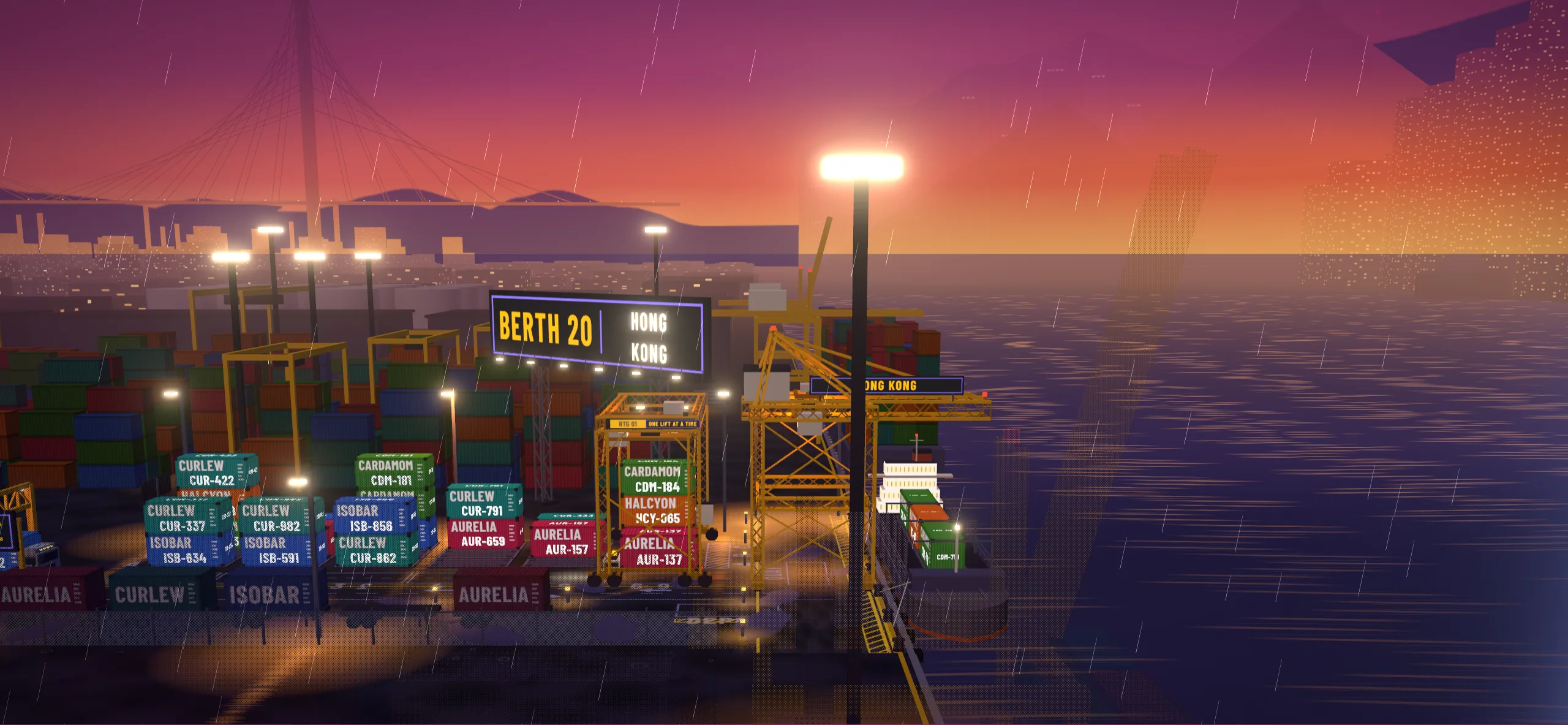
TermOps lets you run this chain in one short shift.
- The gate. A road truck arrives. You send it to an open lane spot before its patience ring runs out.
- The yard. You tell the yard crane where to put a box, or which box to lift onto a truck. Boxes on the load list must be found, even if other boxes are on top.
- The yard truck. You send a yard truck to a lane spot under the crane, then to the quay.
- The quay crane. You pick a slot on the ship. A slot is legal if it is empty and either on the floor or on a filled slot.
- Sailing. The vessel sails when every box on its list is aboard. A missed box costs points. A full, on-time load earns a bonus.
Later ports add more: 40-foot boxes, reefers, hazardous cargo, weather and rush waves at the gate. The terminal chain stays the same.
FAQ
How long does a container stay in a terminal?
It depends on the port and the cargo. A box can wait days in the yard before its ship arrives. Terminals plan this dwell time, because every day a box occupies a slot is a day that slot cannot be used.
What is the difference between a yard truck and a road truck?
A road truck belongs to a trucking company and uses public roads, entering through the gate. A yard truck belongs to the terminal and only moves boxes inside it, mostly between the yard and the quay.
Who decides where each container goes on the ship?
A planner decides, usually with software. The stowage plan balances the vessel, keeps heavy boxes low, separates hazardous goods and arranges boxes by port of discharge. The terminal and the ship's crew both check it.
Play it. Take a five-minute shift at Training.
Play TermOpsKeep reading: the machines that move containers in a terminal, or see the ports you can play.