I work in logistics. Most days, the work is invisible to the people it serves. A product shows up on a shelf, and nobody asks how it got there. For a long time, I did not think much about it either. Then I spent time watching a container terminal work, and I could not stop.
Up close, a terminal is choreography
A container terminal looks like noise from far away. Up close, it is choreography. A truck arrives at the gate. A crane lifts a box into the yard. A yard truck waits under the crane. Another crane, much taller, lifts a box onto a ship. Each machine does one job, and each job waits on another. Nothing moves alone.
What caught me was the timing. Everyone knows what comes next, and everyone is waiting for someone. When it works, it looks calm. When it does not, you can feel it from the other side of the fence.
What one wrong stack costs
The first thing I understood was the stack. Boxes in a yard sit on top of each other, and you can only reach the top one. If the box you need is at the bottom, someone has to move the ones above it first. That is a dig. It costs crane time, and crane time is the thing nobody has enough of.
So a stack is not storage. It is a decision about the future. Put a box where it blocks the one you need tomorrow, and you pay for it tomorrow. I wanted to hand that decision to someone and let them feel it.
The ship that will not wait
The second thing was the ship. A vessel has a sailing time, and it pulls everything toward it. The gate, the yard, the trucks and the cranes all bend around that time. A box that is ready late is a box that misses the ship. That one fact turns a dozen small jobs into one big pressure.
It is the same pressure in every port. That is what made me think it could be a game. A puzzle with a clock and a lot of moving parts is a good game.
Why I made it a game
Nobody sees this work. Games are one of the few ways to let people feel something they cannot visit. A container terminal is closed to most people, and rightly so. It is loud, heavy and dangerous. A game lets you stand in the middle of it, with no risk, and make the calls.
I also wanted to give credit. The people who run terminals solve hard problems, in the rain, at night. If someone plays TermOps and then looks at a ship differently, that is enough for me.
What I kept real
I kept the ideas that make the work hard.
- Stacks, where you reach only the top box, and digs.
- Quay and yard cranes that do one lift at a time.
- Reefers, which need power and a cold bar to watch.
- Hazardous boxes that must sit apart.
- Weight classes, with heavy boxes below light ones.
- A ship's sailing time.
- Weather that slows the work.
What I simplified
I changed what gets in the way of play. Real terminals run on planning software and hundreds of people. In TermOps, one person gives the orders, and a shift lasts five to eight minutes. The terminals are smaller than real ones. The scoring is a game's scoring, not a terminal's. Finished trucks leave by themselves, so you can think about the next job.
Why I chose real ports
I could have made up a harbour. I chose real ones. Montreal, Durban, Gdańsk, Melbourne, Santos, Los Angeles, Hong Kong, Jebel Ali, Singapore and Shanghai are real places, with real weather and a real feel. They are only the first: the plan is to bring ports from all over the world into the game, so the campaign becomes a trip around the world. The terminal operator and shipping lines are fictional, and I name no real company. The ports are there for geography, and for the pleasure of the map.
Why the game is set at dusk
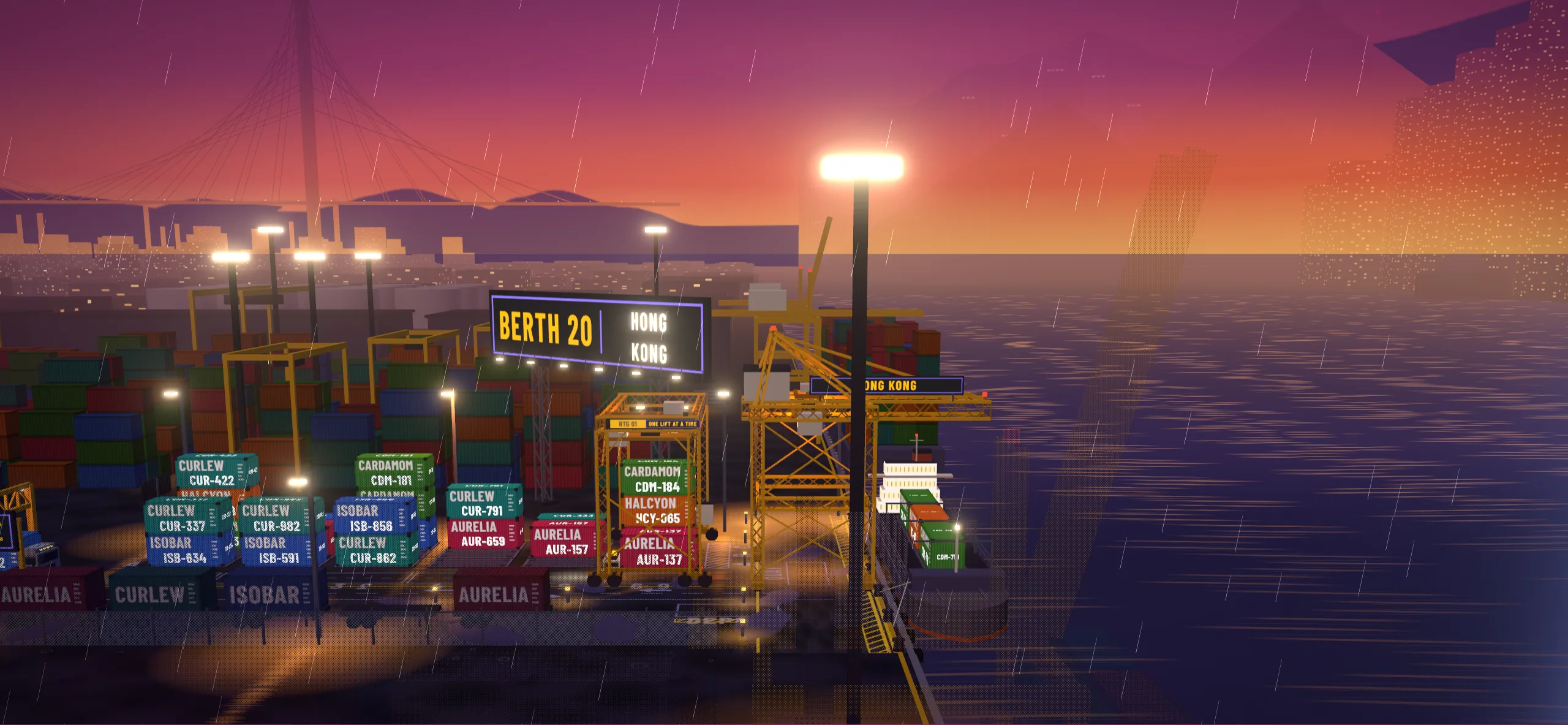
Terminals do not stop at night. The best light for them is dusk: the sky is painted, the lamps come on, the ground goes wet and the cranes turn to silhouettes. I wanted the game to feel like the end of a long day when the ship is nearly ready. It is also easier on the eyes for a five-minute game you will play again.
What comes next
I hope TermOps makes a few people curious about how the things around them travel. If you work in a port, I would like to hear what I got wrong. Write to support.termops@vibe2play.com.
Thank you for playing.
The founder of TermOps, Vibe2play